English

The Science Behind Wall Standing: A 10-Minute Daily Routine for Better Posture and Pain Relief
1.Why “Wall Standing” Is Gaining Global Popularity
In recent years, the wall standing exercise — also called wall posture training — has gone viral across fitness and wellness communities.
It’s promoted as a low-effort, high-benefit movement that anyone can do almost anywhere. Many claim that standing against a wall for just 10 minutes a day can:
Correct poor posture and spinal misalignment
Relieve neck, shoulder, and lower back pain
Strengthen lower limb stability
Aid in weight management
Improve cardiovascular health
But how much of this is scientifically true? Let’s look at what research says.
2.The Science: How Wall Standing Works
For most modern adults, sedentary behavior is the root of many physical problems. Prolonged sitting places uneven pressure on the spine, causing postural imbalances such as forward head posture, rounded shoulders, and anterior pelvic tilt.
Wall standing provides a postural feedback mechanism — using the wall as a reference point for proper alignment.
When performed correctly, it activates deep stabilizing muscles that are often weakened by inactivity:
Deep neck flexors (to align the cervical spine)
Middle and lower trapezius (to stabilize shoulder blades)
Transverse abdominis and multifidus (to support the spine and core)
This activation helps retrain body awareness and restore muscular balance.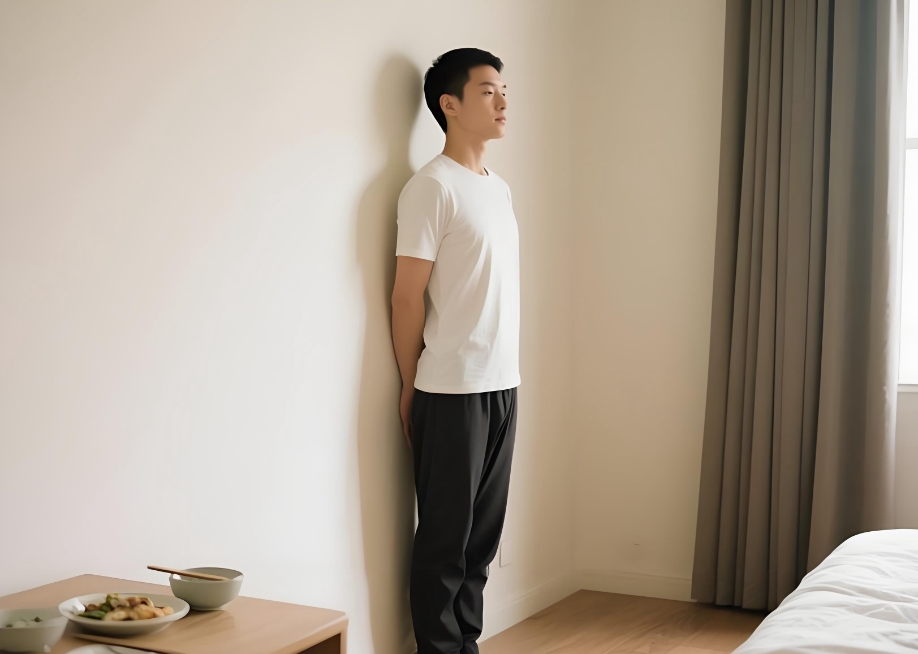
3.Scientifically Proven Benefits of Wall Standing
(1) Improves Posture and Body Alignment
Practicing wall standing regularly helps your body memorize correct alignment — from the head to the pelvis. It reduces forward head posture and rounded shoulders, common among office workers.
(2) Relieves Neck, Shoulder, and Lower Back Pain
As underused stabilizing muscles are reactivated, tension in overworked muscles decreases. This balance alleviates chronic stiffness and discomfort caused by poor posture.
(3) Reduces Health Risks of Prolonged Sitting
Research shows that standing burns 15–30% more calories per minute than sitting. It also enhances blood circulation and may reduce risks associated with a sedentary lifestyle — including cardiovascular disease, obesity, and type 2 diabetes.
(4) Enhances Body Awareness and Breathing
Wall standing trains proprioception — the body’s ability to sense its position in space — and promotes diaphragmatic breathing, both essential for functional movement and stress reduction.
4.The Limits: What Wall Standing Can’t Do
Despite its benefits, wall standing is not a high-intensity workout and should not be seen as a fat-burning shortcut.
Its main value lies in posture correction and muscular activation.
For visible fat loss, muscle toning, or cardiovascular improvement, it should be combined with:
Aerobic exercises (e.g., brisk walking, cycling, or swimming)
Strength training (e.g., squats, lunges, resistance bands)
Think of wall standing as the foundation of a healthy lifestyle — not the full program.
5.How to Do the Wall Standing Exercise Correctly
Step-by-step posture guide:
Stand with your heels 5–10 cm (2–4 inches) away from the wall.
Gently press your head, shoulder blades, buttocks, and calves against the wall.
Tuck your chin slightly and engage your abdominal muscles.
Keep your chest open and shoulders relaxed.
Hold for 5–10 minutes, breathing naturally.
Pro tips:
If you feel back strain, slightly bend your knees.
Start with shorter sessions and gradually increase the duration.
Stop immediately if you experience numbness or sharp pain.
For those with spinal or joint conditions, consult a physical therapist before beginning.
6.Summary: A Simple Yet Powerful Habit
Wall standing is a beginner-friendly, low-impact exercise that helps modern sedentary individuals reconnect with proper posture and muscular balance.
While it won’t replace regular workouts, it serves as a valuable entry point into daily movement and body awareness.
Just 10 minutes a day can help you:
Rebuild your postural stability
Ease chronic muscle tension
Reduce the health risks of prolonged sitting
It’s not about “standing still” — it’s about standing right.
这里是产品和业务范围这里是产品和业务范围这里是产品和业务范围这里是产品和业务范围这里是产品和业务范围这里是产品和业务范围这里是产品和业务范围这里是产品和业务范围这里是产品和业务范围这里是产品和业务范围这里是产品和业务范围这里是产品和业务范围这里是产品和业务范围这里是产品和业务范围这里是产品和业务范围这里是产品和业务范围这里是产品和业务范围这里是产品和业务范围